We listen before we create. Book a discovery call and we'll figure out of if we are what your brand needs — no pressure, just possibilities.
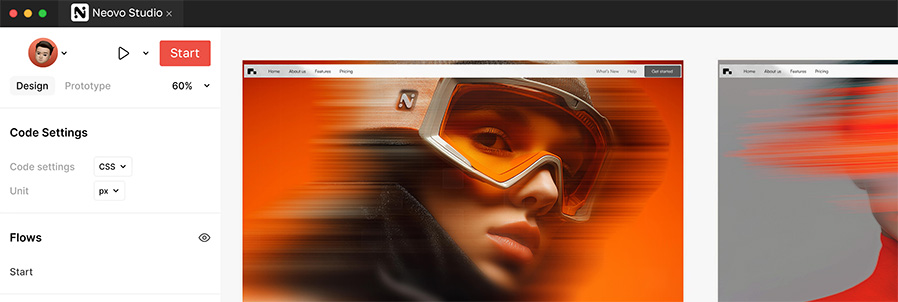

Design Systems That Move: Building Scalable, Brand-Consistent Experiences.

Every growing brand reaches a tipping point. The website no longer quite matches the brochure. The app feels slightly off from the social content. The new team member designs a button that doesn't quite look like anyone else's button. It's subtle at first — and then suddenly, it isn't.
This is where design systems become less of a luxury and more of a necessity. At Neovo Studio, we believe that a well-built design system isn't just a folder of components and colour codes. It's the living infrastructure of your brand — one that should be able to grow, adapt, and move with you.
What Makes a Design System Truly Scalable?
There's a common misconception that a design system is simply a style guide with a few extra steps. In reality, a style guide tells people what your brand looks like. A design system tells them how it behaves.
Scalability in a design system means that when your business evolves — a rebrand, a new product line, an expanded team — the system doesn't crack under the pressure. It flexes. The foundations are modular enough to accommodate change without requiring a rebuild from scratch every time.
At Neovo Studio, we believe that a well-built design system isn't just a folder of components and colour codes. It's the living infrastructure of your brand — one that should be able to grow, adapt, and move with you.

Consistency Is a UX Problem, Not Just a Brand Problem.
Brand consistency is often discussed in terms of aesthetics — and rightly so. But inconsistency has a cost beyond the visual. When users encounter an interface that behaves differently across touchpoints, trust erodes. They may not be able to articulate why something feels off, but they feel it.
A robust design system solves this by creating a shared language between designers, developers, and stakeholders. Everyone is working from the same building blocks, which means fewer handoff errors, fewer one-off solutions, and fewer moments where a user encounters something unexpected.
This is particularly critical for brands operating across digital and physical channels. Whether someone is browsing your site, using your app, or scanning a printed leaflet, the experience should feel like it comes from the same mind — because, effectively, it should.
Motion, Interaction, and the Dimension Most Systems Ignore.
Static design systems do a reasonable job of governing what a brand looks like at rest. But brands don't exist at rest. Buttons are hovered. Menus open. Pages transition. Content loads.
Motion is one of the most underserved components in most design systems — and yet it's one of the most powerful signals of brand personality. A brand that moves with sharp, precise transitions communicates something entirely different from one that eases in softly and slowly. Neither is wrong. But leaving motion undefined means it gets decided in isolation, inconsistently, by whoever happens to be building the feature that week.
At Neovo Studio, we integrate motion guidelines directly into the systems we build — easing curves, duration scales, and interaction states treated with the same rigour as colour palettes and typefaces.

Conclusion.
A Design System Is a Strategic Investment, Not a Deliverable.
The mistake many brands make is treating a design system as a one-time project with a finish line. In reality, it's an evolving infrastructure — one that grows alongside the business, absorbs new requirements, and becomes more valuable over time. The upfront investment pays back compounding returns with every product update, campaign launch, and team member onboarded.
Consistency Is What Turns a Brand Into a Experience.
Individual design decisions can be beautiful in isolation. But it's consistency — applied across every touchpoint, every screen, every interaction — that transforms a collection of assets into something a user genuinely recognises and trusts. A design system is the mechanism that makes that consistency achievable at scale, without requiring heroic effort every time.
Motion and Behaviour Are as Important as Colour and Type.
The brands that will define the next decade of digital experience are the ones that govern not just how they look, but how they move and respond. Building motion principles, interaction states, and behavioural guidelines into your design system from the outset is the difference between a brand that feels alive and one that simply looks good in a static mockup. At Neovo Studio, that full-spectrum thinking is central to every system we build.